



Who really holds the title of “father of AI”? It may not be just one person. Alan Turing sparked the idea that computers could think like people. He imagined devices that could work and learn on their own.
Then there’s John McCarthy. He coined the term "Artificial Intelligence" (AI is the science of making computers smart) and helped build a new field in tech. And Marvin Minsky? He led early experiments with neural networks (special computer systems modeled after the human brain).
Their groundbreaking work laid down the basic ideas behind the smart tech we use every day. Today, we look back at their legacy to see how these early steps paved the way for our modern world.
Who Truly Earned the Title Behind Father of AI?
When we talk about the father of AI, we mean decades of groundbreaking ideas that changed how machines think. Alan Turing, for example, laid the very first brick with his famous 1950 paper "Computing Machinery and Intelligence." In that paper, he introduced the Imitation Game (also known as the Turing Test), a neat way to see if a machine can mimic human thought. His work hinted that machines might one day learn from experience, using simple steps of reasoning.
Then came John McCarthy. He actually coined the term "Artificial Intelligence" during a 1956 meeting known as the Dartmouth Conference. McCarthy loved logical programming so much that he helped create LISP, a language that let researchers explore how machines could copy human thought. He worked closely with friends like Allen Newell, Herbert Simon, and Marvin Minsky, and together they helped turn a curious idea into a real field of study.
Marvin Minsky also broke new ground. He experimented with how machines could "think" and even played around with early neural network simulations. His work showed us that machines could indeed be taught to act smart. Because of these pioneers, the basic ideas of AI still influence modern research every day.
- Alan Turing: His 1950 paper set a roadmap for checking if machines can think.
- John McCarthy: By naming "Artificial Intelligence" and advancing logical programming, he gave the field a strong start.
- Marvin Minsky: His clever experiments with neural networks and his mentorship pushed forward the study of smart machines.
Alan Turing’s Pioneering Role in Shaping the Father of AI Legacy

Alan Turing changed how we see machines with his early ideas in computer science. In 1935, he introduced the idea of a universal computing machine, a design that laid the groundwork for the computers we use today. His vision was so ahead of its time that modern tech still draws inspiration from it. During World War II, Turing led vital codebreaking work at Bletchley Park. It wasn’t just about cracking enemy codes; it also showed how clever thinking and simple math could solve tough problems.
Then in 1950, Turing proposed a game called the Imitation Game, now known as the Turing Test. This test helps us see if a computer can mimic human thought. Turing believed that computers could learn from experience using basic rules called heuristics (simple problem-solving methods). His ideas set the stage for how we evaluate machine intelligence today. The computing world honors his contributions with the A.M. Turing Award, which is like the Nobel Prize for computer science.
Every day, scientists and engineers build smarter systems thanks to Turing’s groundbreaking work. His legacy lives on, inspiring new breakthroughs and reminding us that even the most modern technology can trace its roots back to simple, powerful ideas.
John McCarthy’s Legacy as the Originator of Machine Intelligence
Back in 1956, John McCarthy came up with the name Artificial Intelligence. His idea sparked a whole new area of study that still shapes how we see machine learning today. He also laid the groundwork for logic programming, a simple way for computers to follow clear, step-by-step reasoning, much like our own thought process.
He didn't stop there, McCarthy invented LISP, a coding language that researchers still lean on when handling tough AI challenges. LISP changed the game by treating data as flexibly as human language does, and that fresh approach continues to light the way for modern systems.
In 1964, McCarthy opened the Stanford AI Lab, a lively space where groundbreaking projects took off. One standout project was his work with symbolic reasoning, which even powered early chess matches over telegraph lines in 1966. These early experiments opened the door for systems that eventually grew into interactive models, like conversational AI where machines can chat with us in real time.
His big ideas didn’t just change tech, they inspired a whole generation to push the limits of what machines can do when they try to think like us. Even today, many of the smart tools we rely on trace back to his pioneering work.
Pioneering AI Innovators: Newell, Simon and Minsky’s Contributions

Allen Newell and Herbert Simon changed early AI research with their creation of the Information Processing Language (IPL, a tool to mimic how we think). They used IPL in the Logic Theorist program, which impressively proved 38 out of the 52 theorems from Principia Mathematica. This work showed that machines could follow logical steps much like people do. Later, they refined their ideas into the General Problem Solver, an early model that tackled many different computing challenges.
Marvin Minsky took these ideas further by exploring neural networks (computer models that imitate brain activity). He created SNARC, a simulator that mimicked basic aspects of human learning. And in 1959, he co-founded MIT’s AI Lab, a place that became well-known for advancing robot technology and practical AI. Early tests of his simulator laid the groundwork for today's futuristic robots. His remarkable work earned him the 1969 A.M. Turing Award and reinforced the idea that machines can perform tasks once seen as uniquely human.
Building on the theories of Turing and McCarthy, these innovators set a strong academic path blending deep theories with practical applications. Their pioneering research in algorithmic reasoning and robotics not only pushed the boundaries of AI then but continues to inspire today’s advancements in machine intelligence.
Modern Neural Network Advocates and the Ongoing Father of AI Debate
Geoffrey Hinton shook up neural network ideas with his work on backpropagation (a way to teach computers by fixing errors) at the University of Toronto. He kept on making waves and earned the 2018 Turing Award for changing how computers learn. His work paved the way for a new crop of machine learning tools that work much like human thinking.
Yoshua Bengio, another big name in deep learning, took things even further. His efforts made deep learning a handy tool for many tasks, and his part in the Montreal Declaration pushed for safer and fairer AI practices. People now see these moves as helping to evolve what we call artificial thought.
Andrew Ng left his mark through the Google Brain project. His research and teaching reached audiences worldwide, showing how machines can solve tricky problems with smart, flexible solutions. And over at Facebook, Yann LeCun leads AI research by blending symbolic ideas (using clear symbols to represent concepts) with data-driven methods.
In truth, these modern innovators differ from the early pioneers of AI. Their fresh takes are crucial for tackling today’s challenges in smart systems, proving that AI’s legacy keeps evolving and inspiring new strategies. Their work drives progress and invites us all to stay curious about what’s next.
Milestone Timeline: Key Breakthroughs Defining the Father of AI Title
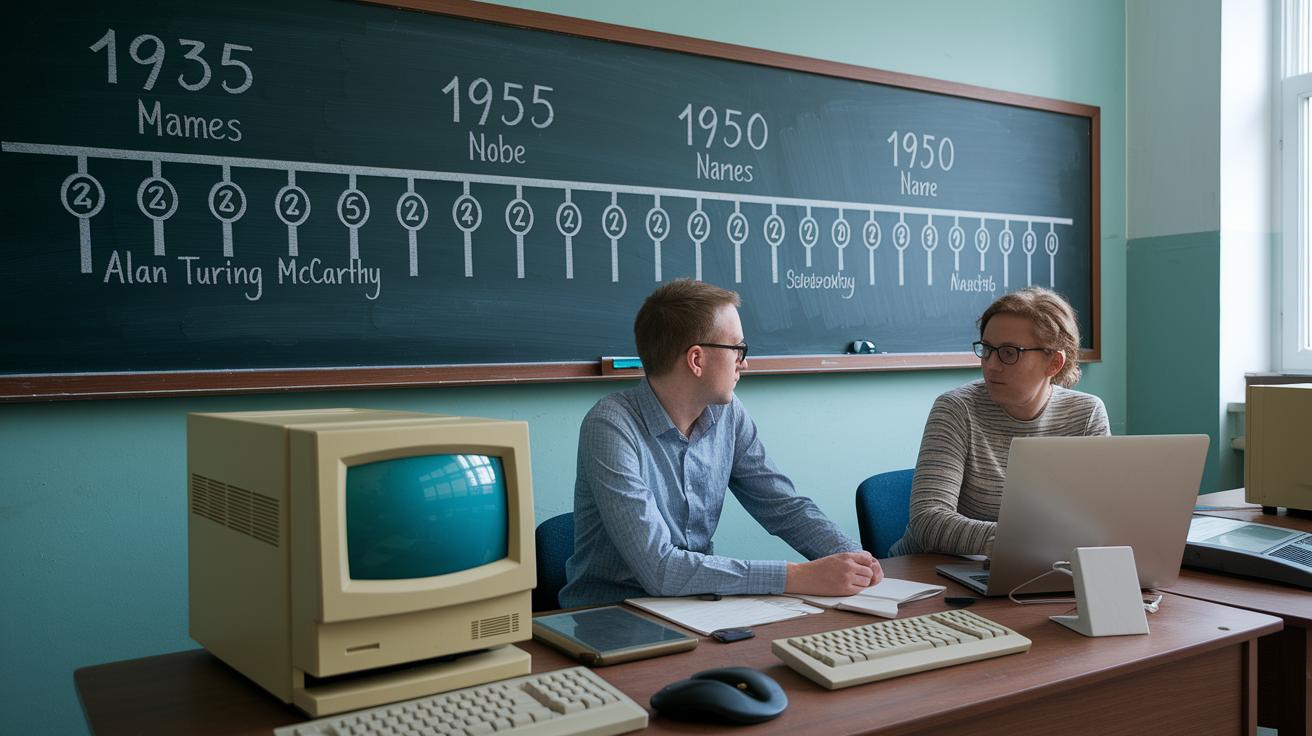
Earlier sections have already shared how icons like Turing and McCarthy shaped early computing. Here, we look at the journey that leads up to today's amazing breakthrough with GPT-4.
Imagine a timeline as a set of stepping stones. It starts with simple puzzles in early computers and moves gradually to an AI that chats almost like a human.
| Year | Milestone | Innovator |
|---|---|---|
| 1935 | Universal Machine Concept | Alan Turing |
| 1950 | Imitation Game Proposal | Alan Turing |
| 1956 | Dartmouth Conference; AI Term Coined | John McCarthy & Associates |
| 1959 | MIT AI Lab Founding | Marvin Minsky |
| 1964 | LISP Release | John McCarthy |
| 2023 | GPT-4 Generative AI Demo | Modern AI Pioneers |
Final Words
In the action, we explored key breakthroughs in AI history, from early computing concepts to symbolic reasoning and pioneering robotics. The discussion highlighted how these milestones paved the way for today's innovations and ongoing debates over the true "father of AI." We looked at groundbreaking work that set the stage for modern machine intelligence.
• Alan Turing – Pioneered computing concepts with his universal machine and the Imitation Game.
• John McCarthy – Coined the term "Artificial Intelligence" and built early machine intelligence foundations.
• Marvin Minsky – Advanced neural simulations and helped form MIT's AI Lab.
Positive progress continues.
FAQ
Father of AI Geoffrey Hinton
The phrase “father of AI Geoffrey Hinton” highlights his groundbreaking work in deep learning and neural networks. His advances in backpropagation have significantly shaped today’s AI research and applications.
Father of AI Alan Turing
The title “father of AI Alan Turing” recognizes his pioneering ideas, from the universal computing machine to the Imitation Game, which laid crucial groundwork for modern theories of machine intelligence.
Who is the actual father of AI?
The actual father of AI remains a subject of debate. Key figures like Alan Turing, John McCarthy, and Marvin Minsky each made pivotal contributions that collectively established the field of artificial intelligence.
Who are the three fathers of AI?
The three fathers of AI are often identified as Alan Turing, John McCarthy, and Marvin Minsky. Their innovative work in computing, conceptualization of AI, and early machine reasoning built the foundation for modern intelligent systems.
Father of AI Google
The label “Father of AI Google” is sometimes linked to modern pioneers such as Andrew Ng and Yann LeCun. Their work at Google and Facebook propelled deep learning research into the mainstream of technology innovation.
Father of AI Nobel Prize
The term “father of AI Nobel Prize” is misleading because no Nobel Prize exists for AI. Instead, luminaries like Alan Turing have received prestigious awards, such as the Turing Award, in recognition of their computing breakthroughs.
Father of AI Wikipedia
The “father of AI” entry on Wikipedia usually covers several influential innovators, including Alan Turing, John McCarthy, and Marvin Minsky, each noted for their groundbreaking methods and lasting impact on the development of AI.
Father of AI warning
The mention of a “father of AI warning” often refers to cautionary statements from leading figures like Geoffrey Hinton, who highlights potential risks and urges careful management of rapidly advancing AI technologies.
Who is the real godfather of AI?
The title “godfather of AI” is attributed to a blend of early pioneers. Innovators such as Turing, McCarthy, and Minsky all contributed essential insights and innovations setting the stage for current and future AI advancements.
What’s the best AI stock to buy?
The question about the best AI stock to buy falls under financial advice rather than historical AI contributions. Consult a trusted investment expert for guidance that matches your financial goals and market conditions.
- Alan Turing: A pioneer who introduced revolutionary computing ideas and the Imitation Game, setting early standards for intelligent machinery.
- John McCarthy: A key figure who coined “Artificial Intelligence” and developed LISP, shaping early AI research and symbolic reasoning.
- Marvin Minsky: An influential researcher who advanced robotics theory and neural network ideas, helping to define the contours of machine intelligence.